New Dachang
World War ZNew Dachang is a remote village in Greater Chongqing whose name carries the memory of a town erased by the construction of the Three Gorges Dam. In the postwar account of Kwang Jingshu, the settlement becomes more than a rural community: it is the place where a local medical emergency reveals the physical signs of the plague and exposes the terror, superstition, and institutional absence surrounding its earliest spread.
A Village Named for a Lost Town
New Dachang was not officially recorded as a named village. Its residents used the name out of nostalgia for Old Dachang, a settlement that had existed since the period of the Three Kingdoms, with farms, houses, and trees believed to be centuries old. When the Three Gorges Dam was completed and the reservoir began to rise, Old Dachang was dismantled brick by brick and reconstructed on higher ground.
The reconstructed site was preserved as a national historic museum rather than restored as a living town. The arrangement created a bitter disjunction: the peasants’ home had been physically saved, but they could now visit it only as tourists. Naming the new hamlet New Dachang maintained a connection to that heritage when ordinary continuity had become impossible. The name therefore joins two kinds of displacement—one caused by the reservoir, the other by the later catastrophe that reached the isolated settlement.
The First Medical Emergency
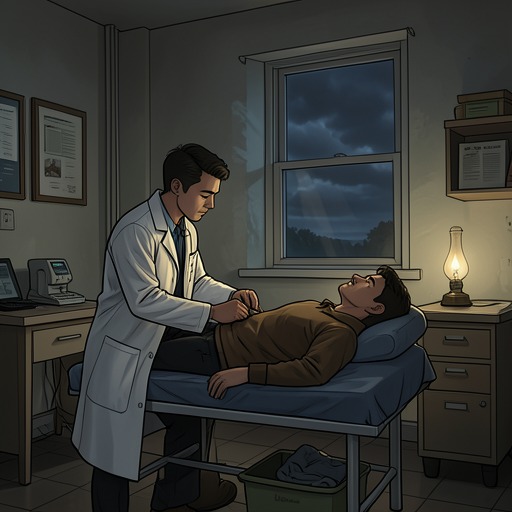
Kwang Jingshu did not initially know that this second New Dachang existed, which explains his confusion when the hospital received an urgent call. The hospital shift had been quiet, despite the rising number of motorcycle and drunk-driving accidents, and Kwang was preparing to leave, smoke a cigarette, and watch the dawn when he was paged. The receptionist, new to the job and unfamiliar with the local dialect, could establish only that an accident or illness required immediate assistance.
The patients had been moved into the village’s new communal meeting hall. Seven people lay on cots, barely conscious, in a cold, damp room of bare cement. The villagers said that no one had cared for them because it was not safe, and Kwang noticed that the door had been locked from the outside. Their fear appeared in their cringing, whispering, prayers, and refusal to approach the sick. Kwang interpreted their behavior through his own national and historical frustration: a country he regarded as entering the Chinese Century still contained communities that, in his judgment, lived amid ignorance and superstition.
The setting’s physical poverty and social isolation sharpen the medical mystery. The villagers had placed the victims together but would not touch them, while the doctor had to work without reliable local assistance. New Dachang thus presents the outbreak not as a controlled hospital phenomenon but as an event encountered at the edge of formal authority, where fear has already begun to replace ordinary care.
The Bite and Patient Zero
The first patient Kwang examined had a fever of forty degrees centigrade and was shivering violently. She was barely coherent and whimpered when he moved her limbs. A wound on her right forearm looked like a bite, but closer examination showed that it had not been caused by an animal. Its radius and tooth marks indicated a small, possibly young human being.
The injury should have been dangerously contaminated, since the human mouth carries abundant bacteria. Yet the wound was unexpectedly clean, with no throbbing infection. Kwang therefore suspected that the bite had introduced the illness while remaining medically anomalous in its own right. The other six patients displayed similar symptoms and similar wounds on different parts of their bodies. The most lucid man explained that they had been injured while trying to subdue him.
Kwang found the suspected source behind the locked door of an abandoned house across town. The boy was twelve years old, bound at the wrists and feet with plastic packing twine. He had rubbed the skin away around the restraints, but there was no blood. His legs and arms bore gouges, and his right big toe was missing, yet those wounds were also bloodless. He writhed like an animal and growled through a gag.
The villagers warned Kwang not to touch the boy because they believed he was cursed. Kwang rejected the warning, put on a mask and gloves, and examined him. The boy’s skin was cold and gray, matching the cement beneath him. Kwang could find neither heartbeat nor pulse. The boy’s eyes were wild and sunken, fixed on the doctor with the attention of a predator, while his bound hands reached toward Kwang and his teeth snapped through the gag. Because the violence of his movements made examination impossible, Kwang ordered two large villagers to help restrain him, despite having no lawful authority to command them.
Isolation, Recognition, and Significance
New Dachang’s importance lies in the collision between an apparently ordinary rural emergency and evidence that violates ordinary medical categories. The villagers’ locked doors, prayers, and refusal to provide care register the outbreak as a social rupture before its nature is fully understood. Kwang’s examination turns the village into a diagnostic threshold: the clean human bite, the absence of blood, the cold gray skin, and the missing pulse force the physician to confront a condition that local language and conventional medicine cannot yet contain.
The settlement also concentrates the book’s contrast between official modernity and lived vulnerability. Greater Chongqing is associated with the ambitions of a rising superpower, but New Dachang has no dependable institutional response in the moment when its residents need one. Its nostalgic name preserves a submerged past, while the outbreak threatens the fragile present built around that loss. The village consequently stands at the intersection of displacement, memory, and biological catastrophe: a reconstructed community becomes the scene in which the dead appear to return and the boundaries of human life begin to fail.